
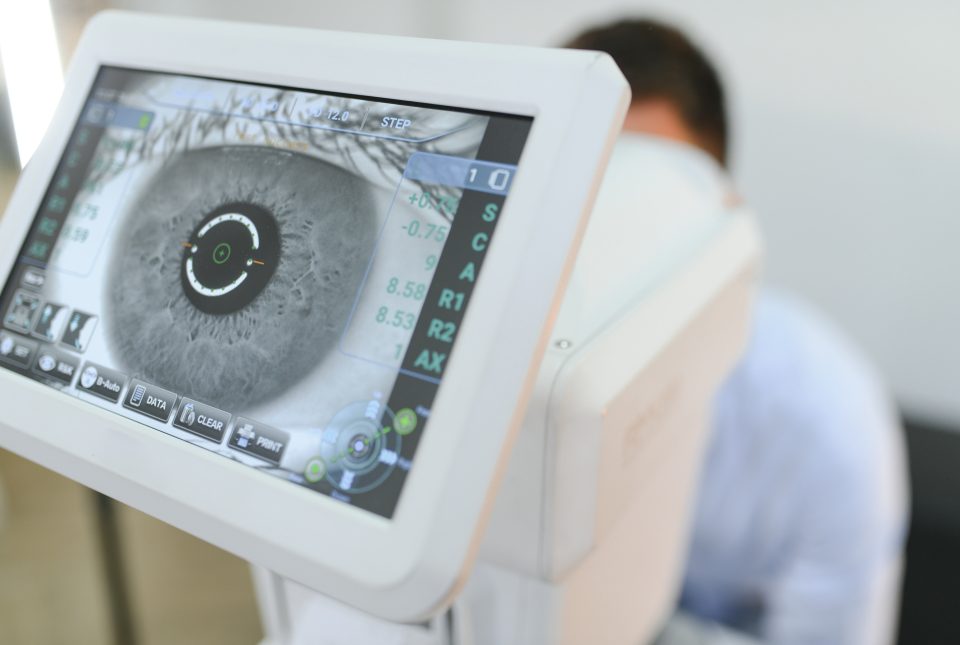
3D OCT eye scans
A 3D OCT scan can detect potentially serious conditions that affect your eyesight and your overall wellbeing, often long before you’d notice any symptoms.
The scan is non-invasive, painless and quick. It lets your optometrist see both the surface of the back of your eye and a three-dimensional image of the layers beneath it.
What is OCT?
OCT stands for optical coherence tomography. It’s an advanced eye scan for people of all ages.
It works a little like ultrasound, but uses light rather than sound waves to show the different layers at the back of your eye. Seeing these layers helps us check for potentially serious conditions such as glaucoma, diabetic eye disease, age-related macular degeneration (AMD), vitreous detachments and more. The machine captures a photograph of the back of the eye (a fundus photograph) and a cross-sectional scan at the same time.

Scans taken over time are a great way for your optometrist to monitor even the most subtle changes in your eye health. Comparing them shows whether a change needs medical attention or whether continued monitoring by our optometrists is enough.
We’ll always give you a full, jargon-free explanation of your eye health, so you understand what we can do to help you achieve the best vision and comfort.
- No contact with your eye
- No bright flash and no discomfort
- A few seconds per eye
- Results explained there and then
- Compared with your previous scans
What happens during your OCT scan?
The scan takes just a few seconds per eye. You’ll rest your chin on a support and look at a fixed point of light while the machine captures the image. There’s no contact with your eye, no bright flash and no discomfort.
Most people don’t need their pupils dilated for the scan, though dilation may still be recommended as part of a wider eye examination if your optometrist wants a closer look at the back of the eye.
Your optometrist reviews the images with you there and then, comparing them with normal, healthy anatomy and, if you’ve had a scan before, with your previous results.
Who should have an OCT scan?
An OCT scan can benefit anyone, but it’s particularly valuable if you:
- have a family history of glaucoma or macular degeneration
- have diabetes
- are over 40, when the risk of many sight-threatening conditions starts to increase
Because OCT can pick up changes years before they affect your vision or show up in a standard eye examination, it’s also useful as a baseline scan when your eyes feel completely healthy, giving your optometrist something to compare future scans against.
Conditions an OCT scan can help detect

- Age-related macular degeneration (AMD): affects central vision and is most common in the over-50s. More about AMD
- Glaucoma: progressive damage to the optic nerve, often with no early symptoms. More about glaucoma
- Diabetic eye disease: changes to the blood vessels at the back of the eye caused by diabetes.
- Macular holes: a small break in the macula that can affect central vision.
- Vitreous detachments: where the gel inside the eye separates from the retina, which is common with age.
OCT scans are part of our enhanced eye exam
You can also add an OCT scan to a standard eye exam.
Book your OCT scan
Call your practice or book online.